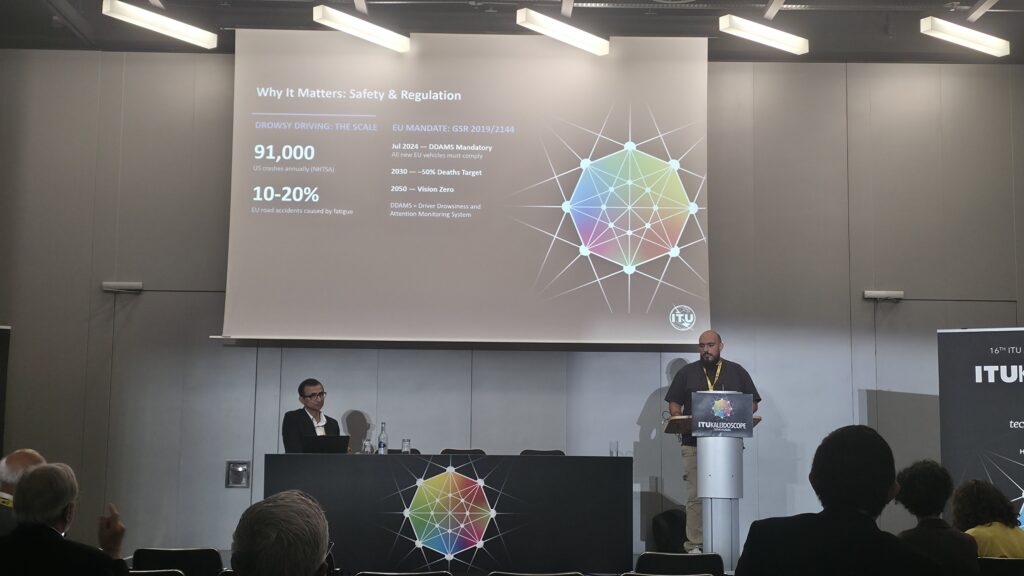
From 7 to 9 July, 2026, the global tech and policy community gathered in Geneva, Switzerland, for the ITU Kaleidoscope conference. Bringing together leading thinkers from industry, policy, and academia, this year’s conference served as a forum for discussing the future for standardised, trustworthy AI.
Representing the ALFIE project, representatives from Universitat Autonoma de Barcelona (UAB) and Catalink presented research addressing two important applications of AI: driver drowsiness detection and sign language interpreting.
Enhancing well-being and public safety: Driver Drowiness Detection
Zenon Lambrou from Catalink presented a research paper titled “Driver Drowsiness Detection on the Edge.” Featured as part of the conference’s specialized track on AI in Healthcare and Well-being Applications, the paper tackles a critical safety issue using next-generation AI applications.
This research focused on evaluating different drowsiness models alongside the custom trained model provided from Catalink Limited on 3 different datasets. It also tested 2 different methods and tested the mobile version of each model. The findings showed that the mobile versions underperformed compared to the computer version. Finally is highlighted that the raw performance of these models might be misleading and that a bias based evaluation might be needed.
Sign Language Interpreting in the Digital Age
Shifting the lens to sign language interpreting, Dr Estel·la Oncins (UAB) presented a poster and paper on Artificial Intelligence Driven Sign Language Interpreting Avatars.
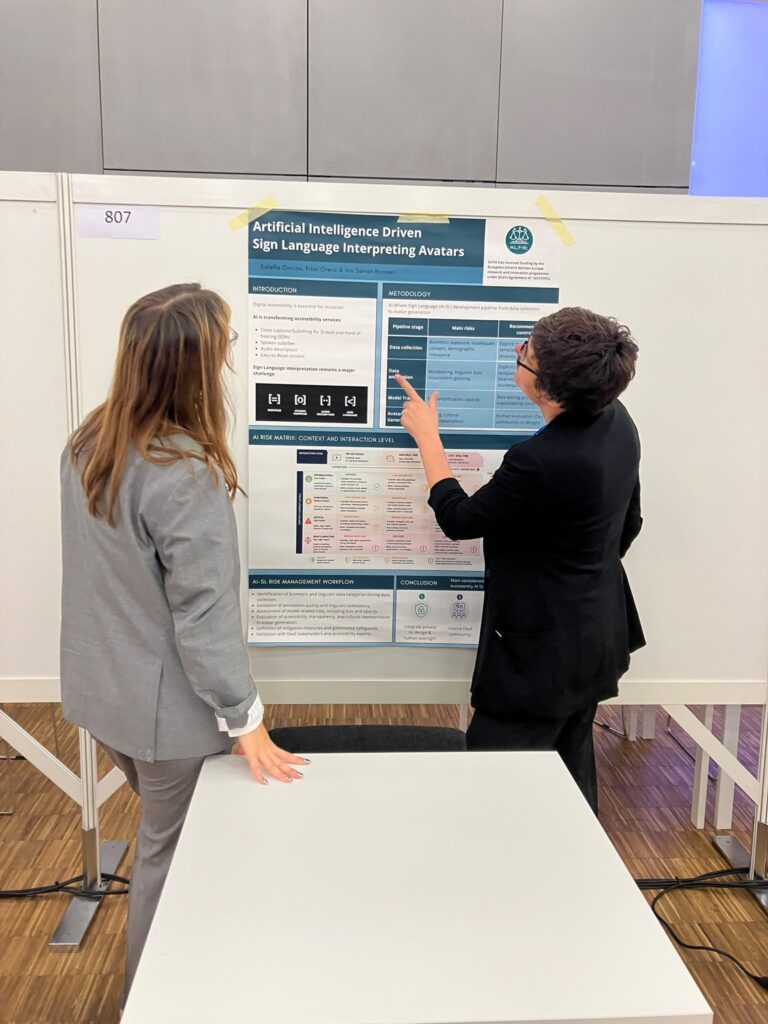
Dr. Oncins’ research explores how AI can be leveraged to create realistic, accurate, and automated sign language avatars. By integrating accessibility standards with advanced AI, this initiative aims to make digital content, broadcasting, and virtual environments seamlessly accessible to the Deaf community. The presentation sparked vital conversations among policy-makers and standardisation experts on how to ensure future digital ecosystems are inclusive by design, rather than as an afterthought.
The ALFIE Mission: Connecting Research, Standards, and Society
The ITU Kaleidoscope conference is unique because of its close ties to international standardization bodies. For the ALFIE project, participating in this event is a crucial step toward turning academic research into global benchmarks. By showcasing innovations in both media accessibility (Sign Language Avatars) and AI safety (Drowsiness Detection), ALFIE continues to demonstrate its core mission: fostering technological ecosystems that are trustworthy, safe, and accessible to everyone, everywhere.
Stay Connected with ALFIE
Want to dive deeper into the papers and posters presented at ITU Kaleidoscope 2026? We will be uploading the official publications and research materials to our Zenodo Community shortly.
Follow us on social media for more live updates from our global research engagements!