Reyhaneh Sohrabi recently presented her work at the XVI International Symposium for Emerging Research in Translation, Interpreting, Intercultural Studies, and East Asian Studies, organized by the Department of Translation, Interpreting and East Asian Studies at the Universitat Autònoma de Barcelona. The symposium brought together more than 30 early-career researchers working across artificial intelligence, language learning, translation, intercultural communication, accessibility, and East Asian studies.
The importance of this conference lay in its interdisciplinary character. It created a space where technical research on artificial intelligence could be discussed alongside questions of language, education, ethics, and culture. This was especially relevant because current AI research cannot be separated from issues such as transparency, reliability, bias, authorship, and responsible academic use. The conference therefore encouraged participants to consider not only what AI systems can do, but also how their limitations should be evaluated and communicated.
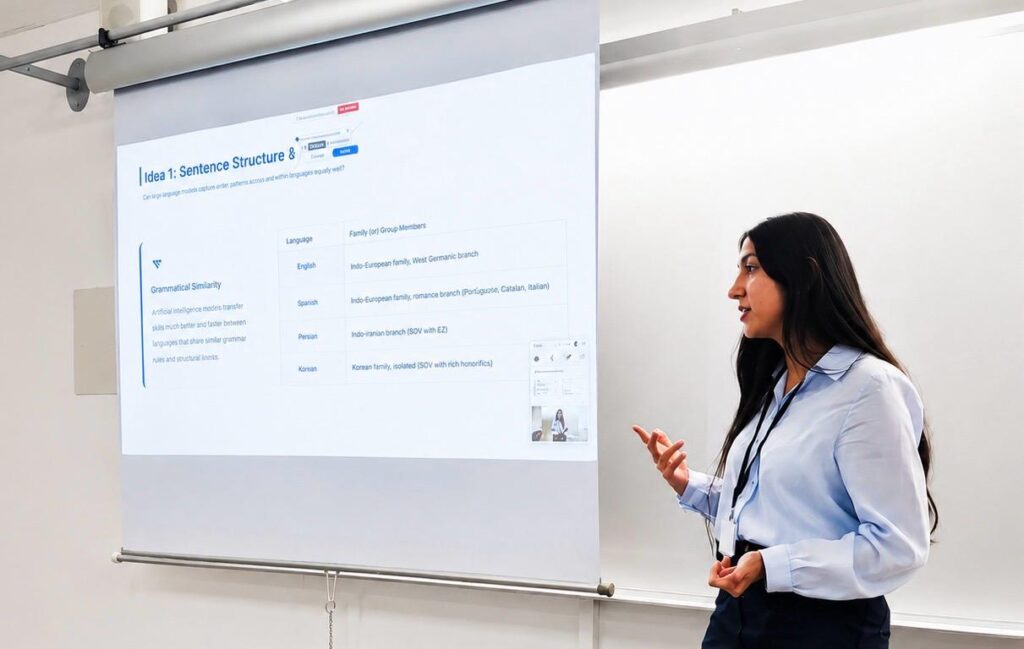
Reyhaneh presented her study, “The Long-Context Gap: Typology and Tokenization in Multilingual LLMs,” during the session on Generative AI and Language Learning. This research was conducted within the ALFIE project, which examines the capabilities, limitations, and broader implications of artificial intelligence across languages and contexts. Situating the study within ALFIE allowed it to contribute to a wider investigation of whether current AI systems operate consistently and fairly across linguistically diverse settings.
Her research examines whether multilingual large language models process long texts equally well across languages. Although modern LLMs are designed to handle increasingly large context windows, their effective performance may depend on the linguistic structure of the input and on how each language is divided into tokens. The study focuses on the interaction between language typology, tokenization, and long-context performance. Languages differ in word order, morphology, grammatical structure, and the amount of information encoded within individual words. They are also represented differently by tokenizers. A sentence that requires relatively few tokens in one language may require many more in another, reducing the amount of meaningful content that can fit within the same context window. Her research investigates whether these differences create systematic performance gaps in multilingual models and whether certain languages are disadvantaged even when the task and content remain comparable.
Following the discussions, the wider program included research on adaptive AI tutors, AI-supported assessment, machine translation ethics, audiovisual accessibility, and intercultural communication. This diversity made the symposium a valuable setting for connecting computational research with broader linguistic and social questions.
Participating in the conference allowed Reyhaneh Sohrabi to communicate her research to an interdisciplinary audience, receive focused questions, and reflect on the wider significance of multilingual LLM evaluation. It also reinforced a central point of her work: larger context windows do not automatically produce equal multilingual performance.