
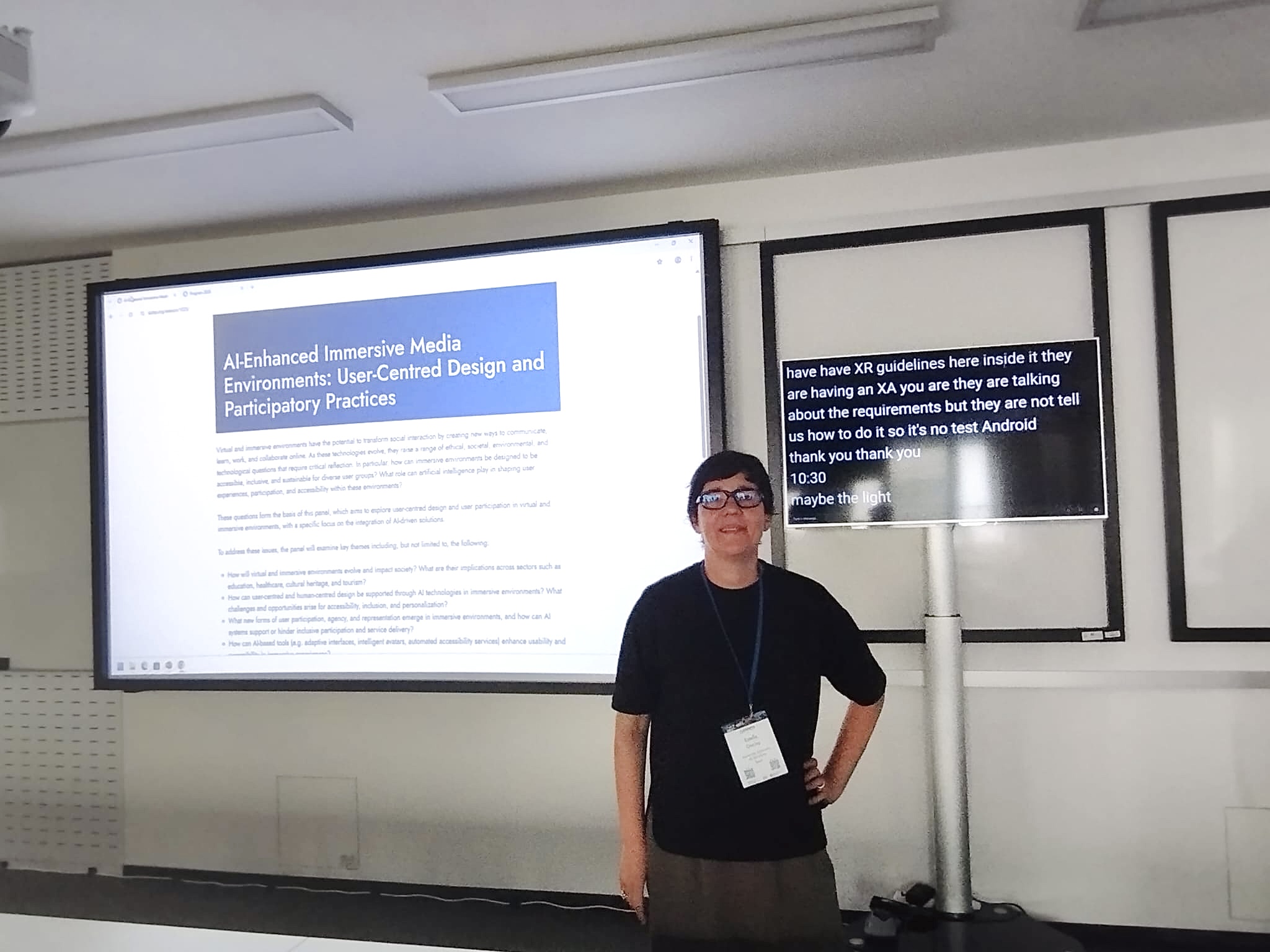
On Friday, 17th July, Estel·la Oncins (Transmedia, Universitat Autònoma de Barcelona & the ALFIE project) chaired a panel exploring how virtual and immersive environments can be designed to be accessible, inclusive, and sustainable for diverse users, and the role artificial intelligence plays in shaping who gets to participate, and how.
Why this matters now?
Immersive technologies are advancing rapidly, with AI increasingly embedded at every layer of how these environments are built and experiences, from adaptive interfaces and intelligent avatars to automated accessibility services.
This combination creates opportunities. For instance, AI-driven personalisation could make immersive spaces far more usable for people with disabilities, older adults, or anyone who doesn’t fit the “default” user profile these platforms are typically designed around.
However, it also raises critical questions about:
- Who decides what “accessible” looks like in a virtual world?
- Can AI systems genuinely support inclusive participation, or do they risk encoding the same biases and exclusions found elsewhere in tech?
- What is the environmental cost of running ever-more elaborate digital environments, and can AI help reduce that footprint rather than expand it?
What the panel explored
Bringing together researchers and practitioners working across accessibility, human-computer interaction, and AI ethics, the panel examined a wide range of interconnected themes:
- The Evolution of Immersive Environments: How virtual spaces are likely to transform sectors like education, healthcare, cultural heritage, and tourism.
- Human-Centered Design: How AI technologies can support, or potentially undermine, accessibility, inclusion, and personalization.
- Participation and Representation: New forms of user agency that emerge in immersive spaces, and how AI systems enable or hinder diverse participation.
- Practical AI Tools: The potential of adaptive interfaces, intelligent avatars, and automated services to enhance overall usability.
- The Regulatory Landscape: Navigating fair access, data protection, security, liability, intellectual property, and digital rights in AI-driven environments.
- Environmental Sustainability: Evaluating whether AI can genuinely mitigate the energy consumption and carbon footprint of immersive technologies.
- Ethics and Trust: Addressing the overarching questions of transparency, bias, user autonomy, and trust in AI-mediated experiences.
You can read an overview of the panel here.