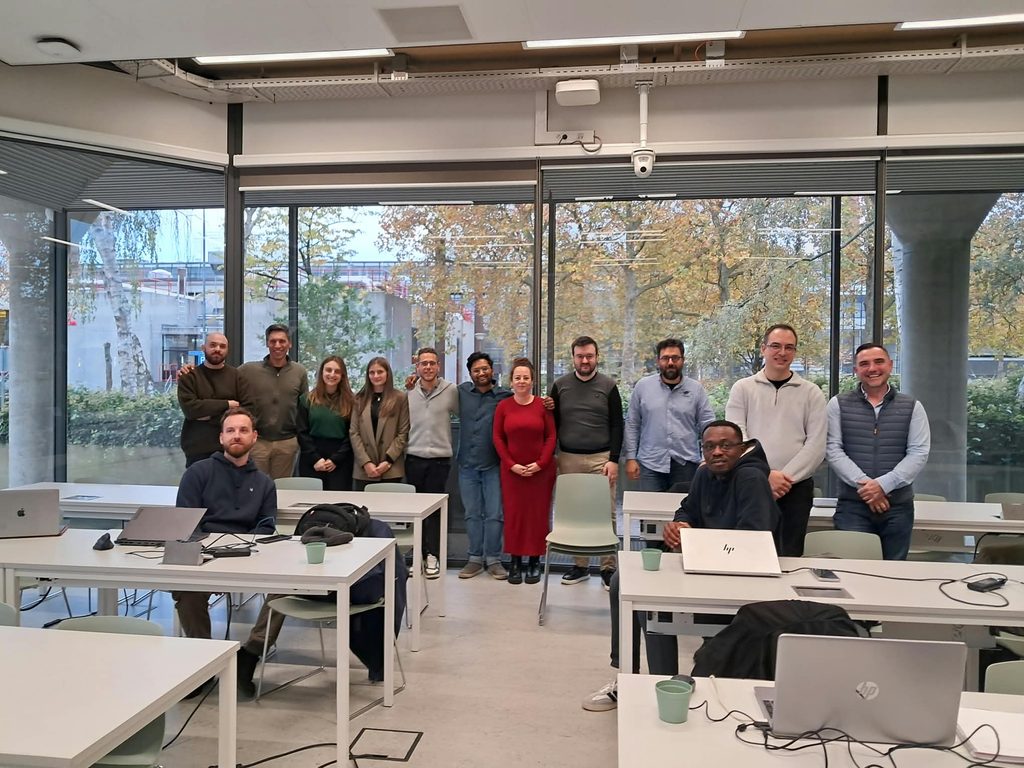
2–3 November 2026 | 4th ALFIE General Assembly | Eindhoven, Netherlands
The 4th ALFIE General Assembly brought project partners together in Eindhoven for two days of research, discussions, and collaborative planning. Hosted by Eindhoven University of Technology (TU/e), the meeting offered an opportunity to review the project’s progress, share recent findings, and discuss the next steps in developing the ALFIE AutoML platform.
Research was an important part of the meeting, with partners sharing published studies and ongoing work across different areas of AI. From adapting machine learning models to changing data and improving explainability, to examining demographic bias in driver monitoring systems and the challenges of speech recognition for underrepresented speakers, the presentations showed how differently AI systems can perform depending on the data, users, and conditions involved. Other contributions explored multilingual misinformation detection, AI governance, trustworthy knowledge graphs, and accessibility technologies.
These research contributions are helping inform ALFIE’s development by exploring approaches to improve its capabilities and highlighting challenges that need to be addressed.
But research is only part of the journey. The next challenge is bringing these insights into practice.
This is where ALFIE’s different components begin to come together. The project is developing an AutoML platform that aims to support AI model creation through multilingual, natural-language interaction. Alongside this, work continues on a data warehouse to support balanced model training, automated model generation, explainability, and approaches that allow models to adapt to changing data while involving humans in the process.
The meeting also provided an opportunity to discuss findings from internally tested use cases, including what had worked well, which issues had emerged, and what needed further attention. These discussions formed part of the ongoing work on platform development, technical requirements, user interfaces, and upcoming validation activities involving Bosch, UAB, and Catalink.
However, making AI model creation more accessible also raises questions about the decisions users make throughout the process.
One development discussed during the meeting was the Ethics Facilitator, an AI agent designed to support ethical reflection rather than provide definitive judgments. Instead of telling users whether their system is ethical or compliant, it is intended to ask guiding questions, point out gaps in reasoning, and help users consider different responsibilities and trade-offs.
This design has also raised practical questions for the consortium. Should an AI use case classified as prohibited automatically block model training, or should certain exceptions be considered? Can users skip or reuse earlier assessments? How should personal data added to AI conversations be handled?
Another important topic was the proposed two-way connection between the Ethics Facilitator and the ETD-Hub. The discussion explored how ethical risks and concerns identified through user interactions could be brought back to the ETD-Hub for expert review, allowing knowledge from practical use to contribute to future ethical assessments.
These discussions are closely connected to ALFIE’s broader development. The project is not only working on the technical processes behind AI model creation, but also on how ethical knowledge, regulatory requirements, and user involvement can become part of those processes.
Looking ahead, the work continues on integrating the different platform components, refining beginner and expert user experiences, addressing issues identified through testing, and preparing for further validation with end users. These steps will be important in understanding how the technical and ethical elements of ALFIE work together in practice.
Across the consortium, Catalink, the University of Brighton, CERTH, Distributed Analytics, Edge Hill University, KInIT, Universitat Autònoma de Barcelona (UAB), Bosch, Eindhoven University of Technology (TU/e), and DBC (Didakdasia) are contributing expertise across research, data management, AI development, ethics, accessibility, and user-centred design. Their work brings together different aspects of responsible AI development. ALFIE incorporates processes to detect potential bias in datasets and apply mitigation measures, alongside ethical assessments and explanations of model behavior, performance, and results. By combining these capabilities with automated model generation and human involvement, the project aims to help users better understand both the models they create and the data and decisions behind them.
The next steps will build on the research, testing, and discussions in Eindhoven, with a focus on refining ALFIE’s tools, addressing the issues identified, and bringing its technical and ethical components together in the next stages of development.