As immersive technologies continue to reshape how we interact with digital environments, questions around safety, accessibility and inclusion are becoming increasingly important. How can we ensure that virtual worlds are not only engaging, but also safe, accessible and inclusive for everyone?
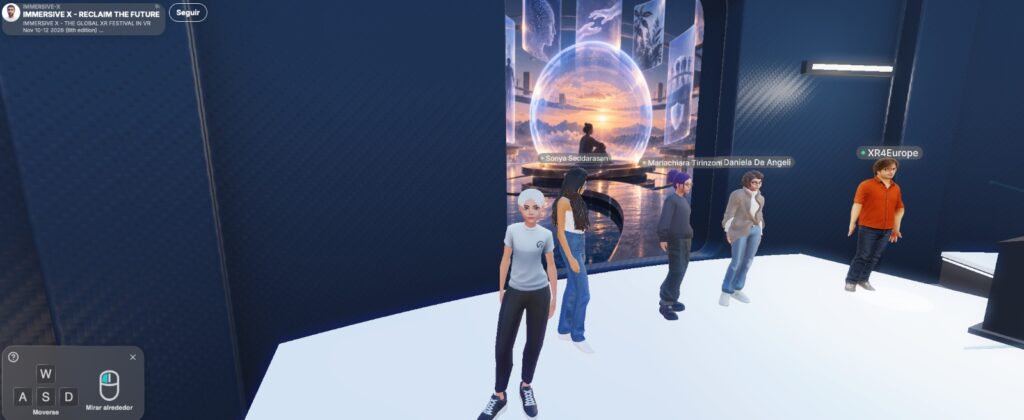
These questions were explored at “How Can We Protect Immersive Experiences? A European Perspective on Codes of Conduct and Ethical Design”, a panel discussion held at IMMERSIVE X Hub on 10 November 2026.
Representing the ALFIE project, Professor Pilar Orero from the Universitat Autònoma de Barcelona (UAB) and TransMedia Catalonia joined fellow experts Mariachiara Tirinzoni and Daniela De Angeli to explore the ethical responsibilities involved in designing and governing immersive environments.
Making immersive environments safer and more inclusive
Immersive technologies create new opportunities for communication, creativity and participation. However, their ability to surround users and generate a strong sense of presence also introduces challenges that extend beyond conventional digital media.
Questions of personal safety, consent, harassment, body autonomy, accessibility and psychological wellbeing are particularly important when considering how people experience virtual environments.
The panel explored how codes of conduct, trauma-informed design and inclusive participation can help address these challenges. It also considered the responsibilities of platforms, creators, communities and regulators in ensuring that immersive environments respect and protect their users.
Connecting ethical design with the ALFIE project
Pilar Orero’s participation provided an important opportunity to connect these discussions with the work of the ALFIE project, which explores how artificial intelligence can support accessibility and inclusion.
Through its development of AI-powered accessibility tools, ALFIE aims to help identify digital accessibility barriers and support improvements to online environments.
Although immersive technologies introduce additional challenges, the underlying principle remains the same: digital experiences should be designed with the needs and rights of all users in mind.
Accessibility should therefore not be treated as an additional feature introduced at the end of development. Instead, it should form part of the design process from the outset, alongside considerations of safety, privacy, transparency and user autonomy.
Pilar’s contribution also highlighted the importance of bringing accessibility expertise into wider conversations about the future of AI and immersive technologies.
A European perspective on responsible immersive technologies
The discussion also considered how Europe’s emphasis on fundamental rights, privacy, inclusion and human-centred regulation can contribute to safer immersive environments.
Translating these principles into practice requires collaboration between researchers, developers, policymakers and communities. It also requires ongoing consideration of how emerging technologies affect different groups of users, particularly those who may face additional barriers to participation.
For projects such as ALFIE, these conversations reinforce the importance of ensuring that technological innovation is accompanied by meaningful consideration of accessibility and ethical responsibility.
Putting people at the centre of immersive experiences
As immersive technologies become increasingly integrated into our digital lives, the challenge is not simply to create more sophisticated virtual environments, but to ensure that these environments work for everyone.
The discussion at IMMERSIVE X highlighted the importance of connecting ethical governance, inclusive design and accessibility when considering the future of immersive experiences.
Through its participation, ALFIE contributed to this wider European conversation, reinforcing the importance of keeping accessibility and human needs at the centre of technological development.
Learn more about the event: How Can We Protect Immersive Experiences? – IMMERSIVE X