
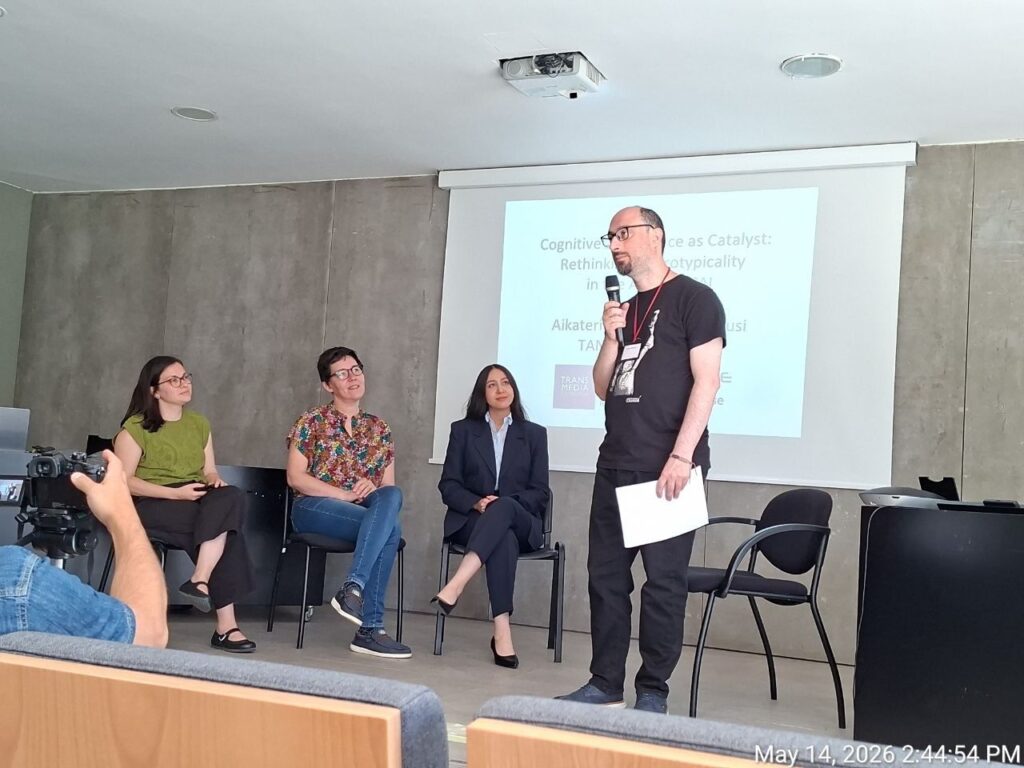
On May 14, representatives from the ALFIE project led a critical panel discussion, as part of The Apocalyspe is Not Coming (TANC) conference titled: “Can we transcend collapse by making accessibility foundational to regenerative world-building?”
Developed jointly by Pilar Orero (UAB) and Haris Shekeris (Catalink), the panel invited participants to frame accessibility not as an afterthought, but as a mandatory precondition for democracy, mutual respect, and regenerative global frameworks. The session interrogated the political, technological, ecological, and affective dimensions of accessibility, exploring how a systemic shift toward inclusive design can counter prevailing technocapitalist logics.
Challenging Cognitive Hierarchies: AI as a Mirror for Neurodiversity
Dr. Aikaterini Tsaousi opened the discussion by examining how the rapid rise of artificial intelligence challenges foundational assumptions surrounding human intelligence and cognition. Dr. Tsaousi argued that contemporary AI inadvertently highlights the fragility and exclusionary nature of neurotypical norms.
Rather than viewing AI solely as a threat, she presented it as an analytical mirror reflecting deep-seated biases within our most widely adopted definitions of intellect. Amidst a global mental health crisis characterized by burnout and widespread anxiety, Dr. Tsaousi leveraged research in accessibility studies and participatory AI development to position technology as an opportunity to dismantle rigid epistemic hierarchies, ultimately opening up digital spaces for diverse cognitive modalities and alternative ways of interacting with the world.
Prompt Literacy and Technical Accountability in Text-to-Image Systems
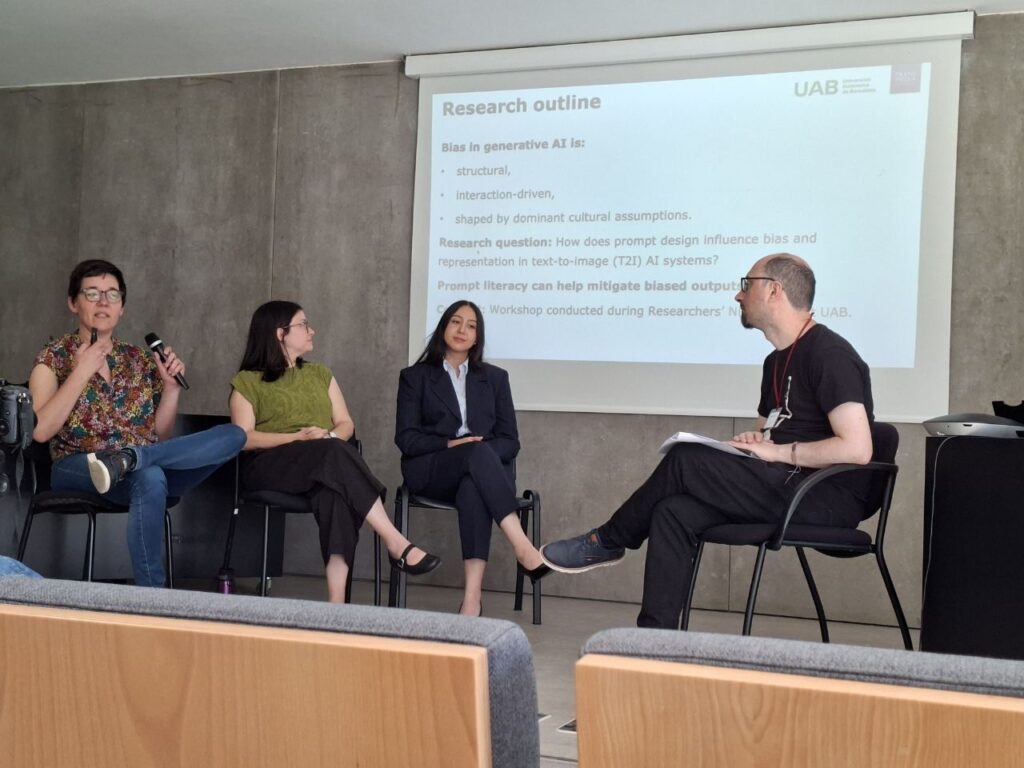
Next, Dr. Estella Oncins presented recent findings regarding algorithmic bias within Text-to-Image systems, emphasizing the critical role of user-end “prompt literacy” in mitigating data-ingrained stereotypes. Demonstrating how under-specified or neutral prompts frequently yield biased results that reinforce societal stereotypes, Dr. Oncins showed that adding granular context and specific details can significantly reduce representational bias.
While advocating for the integration of prompt literacy into modern digital competency and AI education frameworks, she concluded with a vital structural caveat: user behavior alone cannot fix a broken architecture. Fully eradicating systemic bias requires sustained, inclusive co-design collaborations between AI developers, researchers, and policymakers.
Human Variability vs. Technical Stability in Voice AI
Expanding the conversation into speech processing, Reyhaneh Sohrabi explored the intersections of diversity and voice-based AI. Sohrabi highlighted that human speech is inherently variable, shifting across linguistic communities through accents, and changing within a single individual due to aging, illness, or emotional state.
Because current automated speech recognition infrastructures are calibrated around narrow assumptions of vocal stability and conformity, they systematically exclude demographics, including the elderly, individuals with speech impairments, and speakers of underrepresented languages. Drawing from this critique, Sohrabi proposed that true accessibility requires technical infrastructures to remain dynamically open to human physiological variability over time, posing a fundamental ethical question: for whom are modern digital worlds being built?
Interactive Q&A: Structural Bias vs. Model Evolution
Following the presentations, the floor opened for an engaging Q&A session. The audience dialogue brought forward nuance regarding the boundaries between embedded structural bias and intentional prompt vagueness. Participants also debated the current trajectory of foundation models, questioning whether commercial AI systems are genuinely becoming more accessible or if they are simply improving at masking existing biases.
The insights generated during this panel reinforce the ALFIE project’s ongoing mission to bridge academic research with actionable frameworks for equitable technology.