
From Ethical Questions to Practical Choices: How ALFIE Research Addresses Real-World AI Challenges
An AI system can achieve impressive results and still perform differently depending on who uses it. A speech recognition model may struggle with certain accents, a driver monitoring system may respond differently across demographic groups, and an AI-generated sign language avatar may not communicate equally effectively with all users.
These differences raise an important challenge for AI development: understanding not only how well a technology performs, but also who benefits from it, where its limitations appear, and what those limitations mean in practice.
At IEEE CBMI 2026 in Toulouse, researchers from ALFIE partners Universitat Autònoma de Barcelona (UAB) and Catalink (CTL) explored these challenges through contributions to the Women in AI and ETCE sessions. Their work brought together different perspectives on how AI systems represent, interpret, and respond to human diversity.
Human diversity starts with the data: Pilar Orero
One of the challenges in developing responsible AI begins long before a model is deployed: the way data is collected, selected, and annotated.
Professor Pilar Orero’s contribution examined how cultural, linguistic, gender, and religious differences can influence these processes, and how overlooking human diversity may introduce biases into AI systems.
Her discussion also addressed women’s underrepresentation in research, highlighting how diversity among researchers can influence the questions being investigated and the decisions made during technology development.
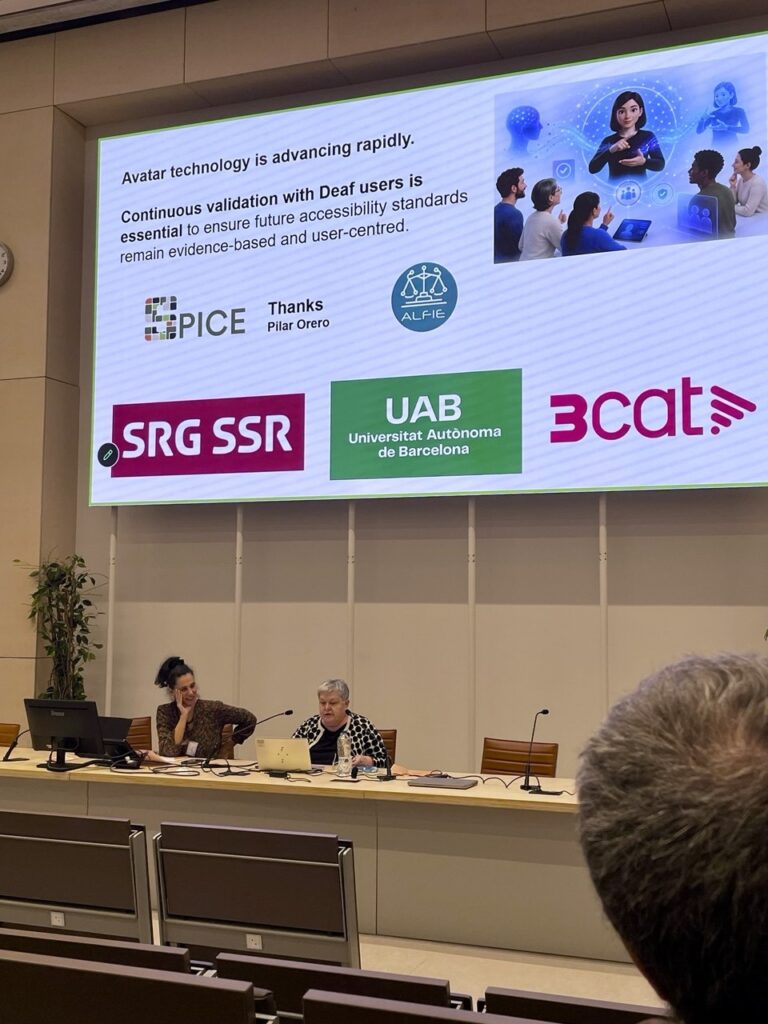
At IEEE CBMI 2026, Professor Pilar Orero also presented research conducted with Estella Oncins and Iris Serrat-Roozen on AI-driven sign language interpreting avatars. Their published study explores how these technologies could improve accessibility for Deaf communities while addressing challenges related to linguistic accuracy, facial expressions, privacy, and user involvement.
The research highlights that making information available in sign language does not automatically make it accessible. The quality of communication, the protection of personal data, and the involvement of Deaf communities are all essential considerations when developing these technologies.
Can AI detect driver fatigue fairly? Zenon Lamprou
Human diversity also presents challenges in AI applications where system reliability has direct safety implications.
At IEEE CBMI 2026, Zenon Lamprou presented research conducted with Georgia Christodoulou and Konstantinos Avgerinakis investigating demographic bias in AI-driven driver drowsiness detection for autonomous vehicles.
Their research examines whether these systems identify signs of fatigue consistently across demographic groups and how differences in performance could affect their reliability.
The challenge is that a model’s overall performance may not fully describe how effectively it works for different individuals. Evaluating demographic differences provides a more detailed understanding of potential limitations that could otherwise remain hidden.
In safety-related applications, such differences are particularly important because a system that performs well on average may still provide less reliable protection for certain groups of users.
Whose voice does AI recognize? Reyhaneh Sohrabi
A related challenge emerges when AI is used to support public participation.
At IEEE CBMI 2026, Reyhaneh Sohrabi presented From Voice to Space, research conducted with Azadeh Shojaei investigating how accent, gender, and disability interact in Automatic Speech Recognition (ASR) performance, with implications for inclusive public co-design.
The research addresses an important limitation of conventional evaluation: measuring average transcription accuracy does not necessarily reveal whether a system performs consistently across different speaker groups.
By examining demographic characteristics and their interactions, the study investigates differences in recognition performance that may be overlooked when these characteristics are evaluated separately.
This matters particularly in participatory urban design, where citizens may contribute ideas and concerns through spoken communication. If an ASR system transcribes some speakers less accurately than others, their contributions may be represented differently in the resulting text.
The research therefore highlights the importance of examining both transcription accuracy and demographic differences when assessing whether speech technologies can support inclusive public participation.
Although these studies focus on different technologies, they address a shared challenge at the heart of ALFIE’s mission: making AI more accessible also requires understanding how its performance, limitations, and potential risks differ across people and communities.
Together, the research provides different perspectives on this challenge. Studies of data representation explore how bias can enter AI development from its earliest stages. Research on sign language avatars identifies linguistic, ethical, and accessibility requirements. Investigations into driver drowsiness detection examine demographic fairness in safety-critical applications, while speech recognition research reveals how performance differences may affect people’s ability to participate.
These connections are important for ALFIE’s work on making AI development more accessible and responsible. They show why technical performance alone is insufficient and why considerations such as data diversity, demographic fairness, accessibility, and user involvement need to inform how AI systems are developed and evaluated.
More importantly, they demonstrate that responsible AI cannot rely on a single evaluation approach. Different applications require different evidence, expertise, and ways of understanding the people who will use them.
For ALFIE, bringing these research perspectives together helps connect ethical principles with practical development decisions, supporting AI technologies that are not only easier to create, but also more reliable, inclusive, and responsive to real human needs.