To mark Global Accessibility Awareness Day, TransMedia Catalonia, in partnership with the ALFIE project and FORSEE (Forging Successful AI Applications for European Economy and Society), hosted its 4th Access Talk.
The webinar moved past superficial tech optimism to address a critical, urgent frontier: the intersection of artificial intelligence, accessibility, and inclusion. What followed was an honest, deeply necessary reality check on how current European legislation is failing the very people it aims to protect.
If you missed the live event, you can watch the full webinar recording here. Otherwise, here are the three major takeaways that every tech developer, policymaker, and disability advocate needs to know.
1. The Legal Contradiction: AI Act vs. European Accessibility Act
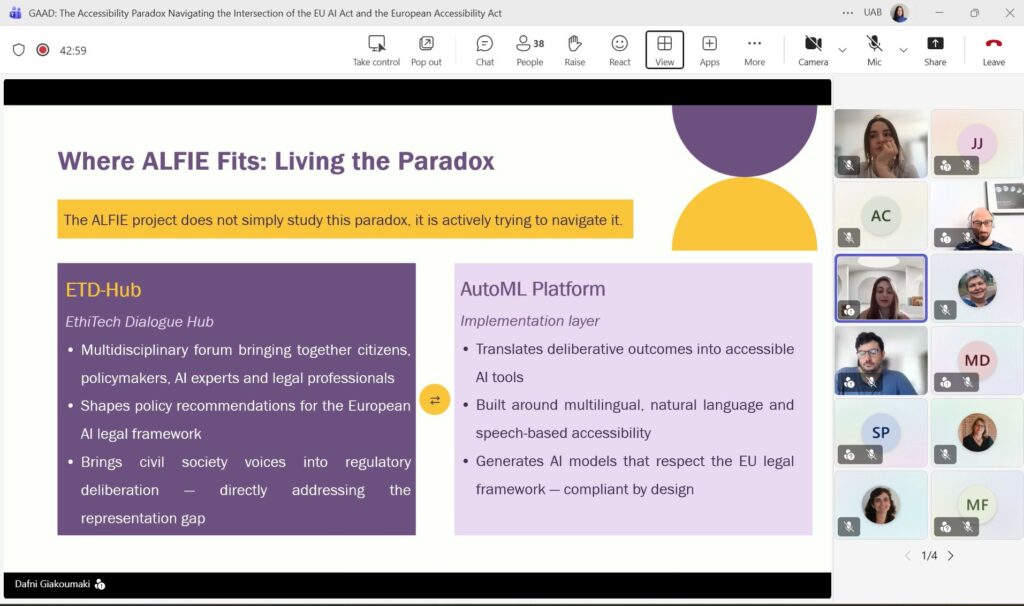
Daphne Giakoumaki brought to light a jarring legislative paradox currently unfolding in Europe. Two landmark regulations, both legally binding and both in force, are pulling developers in completely opposite directions:
- The EU AI Act strictly restricts AI systems from detecting or tracking a user’s disability status to safeguard personal data and prevent bias.
- The European Accessibility Act (EAA) mandates that AI-driven technologies must actively adapt to a user’s disability to ensure equal access.
This leaves tech creators in an impossible “Catch-22.” How can an AI system adapt to a user’s specific accessibility needs if it is legally barred from recognizing that those needs exist?
2. The Cost of Missing Voices
The root cause of this legislative knot comes down to representation. Alexandros Minotakis emphasized that these regulatory missteps do not happen in a vacuum:
“Behind every regulation that misses the mark, there are people whose voices were never part of the conversation.”
When policymakers draft tech laws without the active, leading participation of the disability community and accessibility experts, the resulting laws lack real-world viability. Echoing this sentiment, Haris Shekeris reminded the audience of a sobering truth: good intentions are simply not enough. In fact, the road to systemic exclusion is frequently paved with them.
3. The Path Forward: “Double Compliance”
The panel didn’t just diagnose the problem; they offered a clear, actionable blueprint for the future of tech development: Double Compliance.
To bridge the gap between privacy (AI Act) and inclusion (EAA), the tech industry must shift its approach in three fundamental ways:
- Co-Design from Day One: Accessibility and data privacy can no longer be treated as separate, after-the-fact compliance checkboxes. They must be engineered together from the very beginning of the lifecycle.
- User-Declared Needs over System Detection: Instead of relying on automated, system-led AI detection to “guess” or track a disability, platforms should empower users to declare their own interface preferences.
- Dynamic Consent: Move away from static, one-time “Agree to Terms” checkboxes. Consent regarding accessibility data should be a continuous, transparent dialogue between the user and the system.
Join the Conversation
As AI continues to integrate into our daily lives, we are left with a critical question: What would it take for tech regulation to actually reflect and protect the people it is meant to serve?
Don’t forget to watch the full webinar panel here to dive deeper into the discussion.