
A city can become more digital, more connected, and more automated.
But does that automatically make it better for everyone?
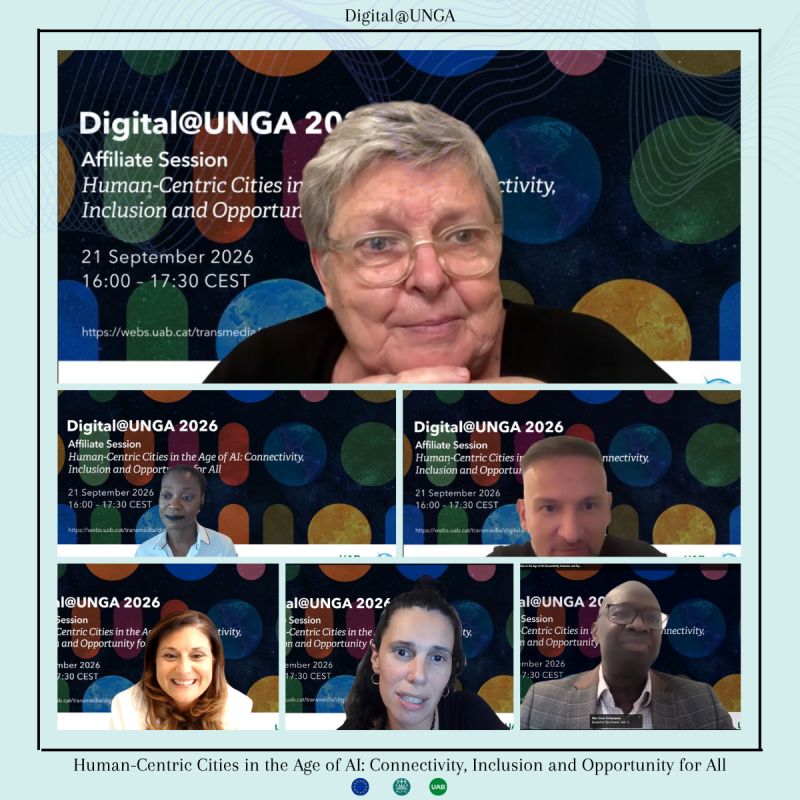
This question sat at the heart of DIGITAL@UNGA: Human-Centric Cities in the Age of AI, a joint event co-hosted by Universitat Autònoma de Barcelona (UAB) and the International Telecommunication Union (ITU).
Drawing over 300 participants from more than 50 countries, the event highlighted a growing global consensus: as artificial intelligence integrates into the fabric of urban life, technology must serve citizens—not the other way around.
Professor Pilar Orero, from the ALFIE project contributed to this conversation alongside Uglješa Stankov, Bamidele Adebisi, Nefeli Georgakopoulou, Hlekiwe Kachali, Aline Matta and Cristina Bueti, bringing together perspectives from research, industry, cities and international organizations.
For ALFIE, this matters because inclusive AI is not only about whether a system performs well. It is also about whether people can access it, understand it, question it and remain part of the decision-making process.
That means:
- Thinking about accessibility before deployment.
- Including people before decisions are made.
- Keeping meaningful human choices available.
- And asking not only whether a system works, but who it works for.
Because a truly smart city is not the one with the most AI. It is the one where progress does not leave people behind.
Interested in finding out more?
Follow this link to the full recording: https://shorturl.at/WUhdx