
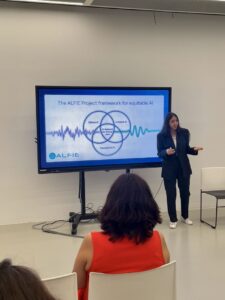
ALFIE participated in the European Researchers’ Night
At this year’s European Researchers’ Night, our team had the opportunity to present key insights from the ALFIE Project, focusing on our ongoing work to build frameworks for equitable and trustworthy artificial intelligence. A central highlight of the presentation was researcher Reyhaneh’s discussion on how we can operationalise fairness in AI design. The ALFIE Framework for Equitable AI At the heart of the ALFIE project is the recognition that AI systems must be designed for diverse user bases from the ground up. The framework brings together three core pillars: Ethical AI: Ensuring algorithmic governance respects human rights, fairness, and safety. Inclusive AI: Designing interfaces and
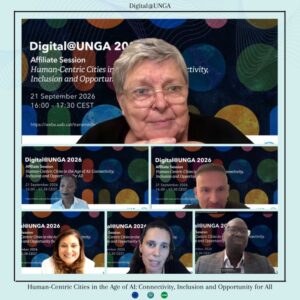
ALFIE at UNGA: Human-Centric Cities in the Age of AI
A city can become more digital, more connected, and more automated. But does that automatically make it better for everyone? This question sat at the heart of DIGITAL@UNGA: Human-Centric Cities in the Age of AI, a joint event co-hosted by Universitat Autònoma de Barcelona (UAB) and the International Telecommunication Union (ITU). Drawing over 300 participants from more than 50 countries, the event highlighted a growing global consensus: as artificial intelligence integrates into the fabric of urban life, technology must serve citizens—not the other way around. Professor Pilar Orero, from the ALFIE project contributed to this conversation alongside Uglješa Stankov, Bamidele Adebisi, Nefeli Georgakopoulou, Hlekiwe Kachali,
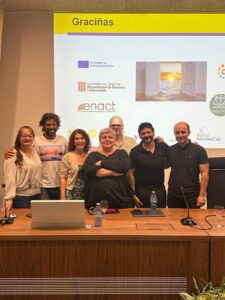
ALFIE presented at seminar in University of Vigo
Professor Pilar Orero with the organisers of the University of Vigo On September 18th, Professor Pilar Orero presented the ALFIE project to an audience of 30 researchers at the University of Vigo as part of their ongoing departmental seminar series. Pilar’s presentation centered on the evolving landscape of audiovisual accessibility and universal access in Spain, highlighting both the progress made and the critical work still needed to ensure digital and media environments are truly inclusive. Seminar poster: Audiovisual accessibility and universal access to culture in Spain. Key Highlights from the Seminar Advancing Universal Access: Pilar detailed how universal access must move beyond compliance to become
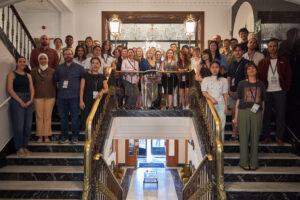
Seeing Ethical AI Through Different Lenses
By Reyhaneh Sohrabi, PhD candidate, UAB. What happens when an NLP scientist, an architect, a physician, a geneticist and a machine-learning engineer examine the same AI system? They often notice completely different risks, and that was one of the most valuable aspects of the Data Science and Artificial Intelligence for Social Welfare Challenge, held in San Lorenzo de El Escorial. The course brought together doctoral researchers and early-career professionals from different universities, countries and academic backgrounds. I (Reyhaneh Sohrabi) attended as an NLP scientist alongside Azadeh Shojaei, an architect specialising in urban design from UAB. Our fields approach technology from different perspectives. I study language,
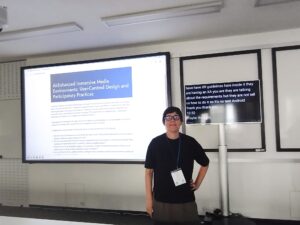
Designing the Future: ALFIE representatives chair panel at the ICCHP Conference in Czechia
On Friday, 17th July, Estel·la Oncins (Transmedia, Universitat Autònoma de Barcelona & the ALFIE project) chaired a panel exploring how virtual and immersive environments can be designed to be accessible, inclusive, and sustainable for diverse users, and the role artificial intelligence plays in shaping who gets to participate, and how. Why this matters now? Immersive technologies are advancing rapidly, with AI increasingly embedded at every layer of how these environments are built and experiences, from adaptive interfaces and intelligent avatars to automated accessibility services. This combination creates opportunities. For instance, AI-driven personalisation could make immersive spaces far more usable for people with disabilities, older adults,
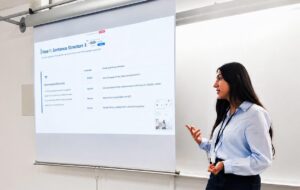
Do Large Language Models Process Every Language Equally Well?
Reyhaneh Sohrabi recently presented her work at the XVI International Symposium for Emerging Research in Translation, Interpreting, Intercultural Studies, and East Asian Studies, organized by the Department of Translation, Interpreting and East Asian Studies at the Universitat Autònoma de Barcelona. The symposium brought together more than 30 early-career researchers working across artificial intelligence, language learning, translation, intercultural communication, accessibility, and East Asian studies. The importance of this conference lay in its interdisciplinary character. It created a space where technical research on artificial intelligence could be discussed alongside questions of language, education, ethics, and culture. This was especially relevant because current AI research cannot be separated